Buy mobilephonesshop.com ?
We are moving the project
mobilephonesshop.com .
Are you interested in purchasing the domain
mobilephonesshop.com ?
domain@kv-gmbh.de · 0541-91531010
Buy mobilephonesshop.com ?
What are the problems with dative and accusative cases?
The main problem with dative and accusative cases is that they can be confusing for language learners due to their different functions in a sentence. Distinguishing between when to use the dative case (indicating the indirect object) and the accusative case (indicating the direct object) can be challenging, especially in languages with complex case systems. Additionally, the declension of nouns, pronouns, and adjectives in these cases can vary depending on the language, adding another layer of difficulty for learners. **
How can I differentiate between the dative and accusative cases?
In German, the dative case is used to indicate the indirect object of a sentence, while the accusative case is used to indicate the direct object. One way to differentiate between the two cases is to ask the question "to whom?" or "for whom?" to determine if the noun is in the dative case. If the answer is the indirect object, then the noun is in the dative case. If the answer is the direct object, then the noun is in the accusative case. Additionally, certain prepositions and verbs require specific cases, so paying attention to these patterns can also help differentiate between the dative and accusative cases. **

Similar search terms for Accusative
Top-Angebote
Products related to Accusative:
-
Inspire Select 12 Pcs Decorative Furniture Corner Protectors Carved Triangle Brackets For Boxes, Cabinets & Storage Cases 12 PcsProtect your furniture while adding a touch of classic charm with a simple upgrade that makes a big visual difference. These decorative furniture corner protectors are designed to reinforce and protect the edges of boxes, cabinets, and storage cases...45,94 $*Shipping: 0,00 $Secure redirect to the provider
-
Ultra PRO Small Deck Protectors - White - 60ct - Card Game AccessoriesProtect your trading cards with these Ultra PRO Small Deck Protectors. Each pack contains 60 white sleeves made from acid-free, non-PVC polypropylene, helping to safeguard cards from scratches and everyday handling wear. The clear front lets the artwork and card details remain visible, while the textured matte back helps prevent sleeves from sticking together during use. The finish is designed to provide a smooth shuffling feel for card games and collection storage. These small-size sleeves fit Yu-Gi-Oh! and Cardfight!! Vanguard trading cards.4,09 £*Shipping: 3,95 £Secure redirect to the provider
-
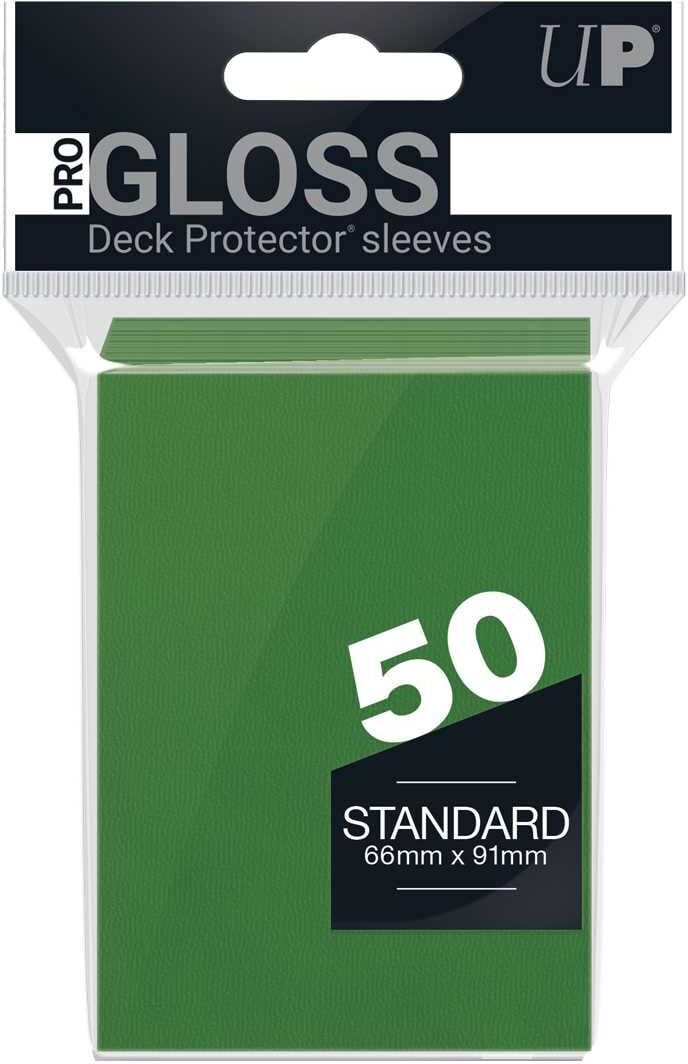
Ultra PRO Standard Deck Protectors 50ct - Green - Trading Cards AccessoriesProtect your trading cards with these Ultra PRO Deck Protectors. This pack of 50 green sleeves is made from acid-free, non-PVC polypropylene to shield cards from scratches, handling marks, and everyday wear. The clear front provides a high-clarity view of the card artwork, while the textured matte back helps reduce sticking between sleeves and supports smooth shuffling during play. These sleeves are designed for standard trading cards, including popular games like Pokémon and Magic: The Gathering.3,09 £*Shipping: 3,95 £Secure redirect to the provider
-
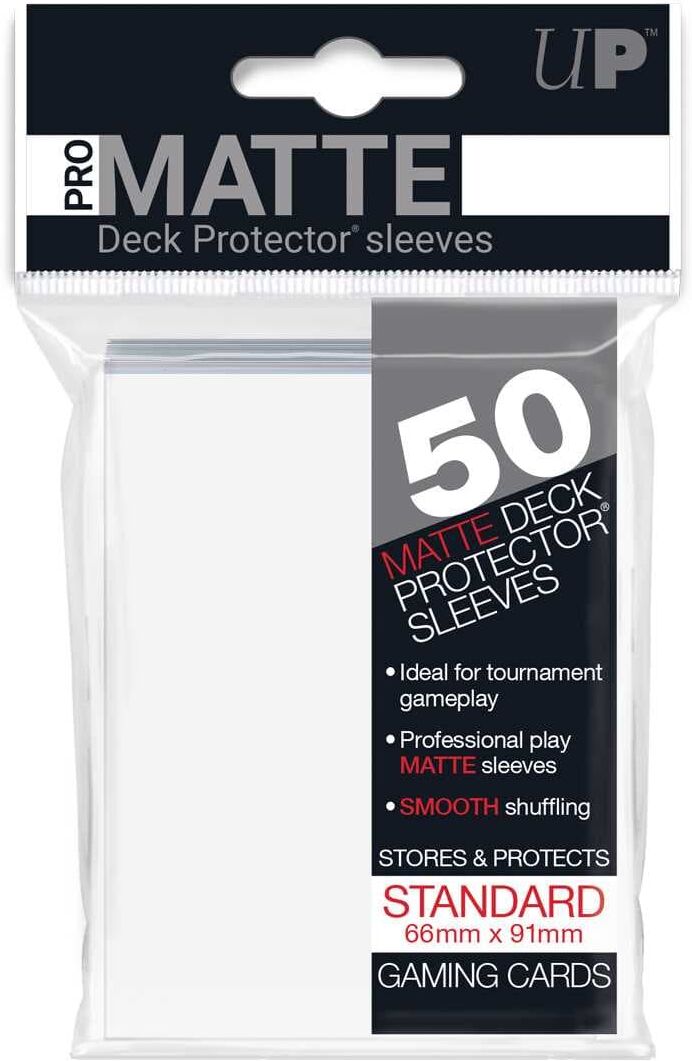
Ultra PRO Matte Standard Deck Protectors 50ct White - Card Game AccessoriesProtect your trading cards during play and storage with Ultra PRO Matte Standard Deck Protectors. Each pack contains 50 acid-free, non-PVC polypropylene sleeves in white, designed to shield cards from scratches and everyday wear. The matte finish reduces glare during gameplay, while the textured matte back provides a secure feel and prevents sleeves from sticking together. The smooth shuffle surface is suitable for regular tabletop card play. These sleeves are compatible with standard-size trading cards, including Pokémon and Magic: The Gathering cards. Please check the dimensions of your cards before use to ensure compatibility.3,32 £*Shipping: 3,95 £Secure redirect to the provider


-
How can one distinguish between the accusative and dative cases?
In German, the accusative case is used to indicate the direct object of a sentence, while the dative case is used to indicate the indirect object. One way to distinguish between the two cases is to ask "whom?" or "what?" for the accusative case and "to/for whom?" or "to/for what?" for the dative case. Additionally, the accusative case often involves movement or action towards something, while the dative case often involves the recipient of that action. It's important to pay attention to the articles, pronouns, and adjectives in the sentence, as they will change depending on whether the noun is in the accusative or dative case. **
-
Who can help me understand the dative and accusative cases?
If you are struggling to understand the dative and accusative cases in a language, you can seek help from a language tutor, teacher, or professor who specializes in that language. They can provide you with explanations, examples, and exercises to help you grasp the concepts better. Additionally, online resources such as language learning websites, forums, and textbooks can also be useful in understanding the dative and accusative cases. **
-
'Genitive or accusative?'
The genitive case is used to show possession or relationship between nouns, while the accusative case is used to show the direct object of a verb. In general, the genitive case is used to indicate ownership or association, while the accusative case is used to indicate the direct object of a verb or the object of a preposition. The choice between genitive and accusative depends on the specific context and the grammatical rules of the language being used. **
-
Dative or accusative?
Dative and accusative are two different cases in grammar that indicate the relationship between a verb and its object. The dative case is used to show the indirect object of a verb, while the accusative case is used to show the direct object. To determine whether to use dative or accusative, you need to consider the verb in the sentence and identify whether the object is receiving the action directly (accusative) or indirectly (dative). **

Genitive or accusative?
The genitive case is used to show possession or relationship between nouns, while the accusative case is used to show the direct object of a verb or the object of certain prepositions. In general, the genitive case is used to indicate possession or belonging, while the accusative case is used to indicate the direct object of a verb or the object of a preposition. The choice between genitive and accusative depends on the specific context and the grammatical rules of the language being used. **
In which cases is the preposition "auf" used in the dative and accusative cases?
The preposition "auf" is used in the dative case when indicating location or position, such as "auf dem Tisch" (on the table) or "auf der Straße" (on the street). It is used in the accusative case when indicating direction or movement towards a place, such as "auf die Insel" (to the island) or "auf den Berg" (up the mountain). **
Top-Angebote
Products related to Accusative:
-
Multicon Wholesale Hub Mobile Phone Screen Repair Tool Kit Professional Screwdriver Set For IPhone & Smartphones Mobile Phone Screen Repair Tool Kit Professional Screwdriver Set For IPhone & SmartphonesTransform your phone repair experience with this versatile 20 in 1 mobile phone screen opening repair tool kit. Whether youre fixing a cracked screen or tackling other repairs, this highquality set is designed for efficiency and precision. Its...63,97 $*Shipping: 0,00 $Secure redirect to the provider
-
Inspire Select 12 Pcs Decorative Furniture Corner Protectors Carved Triangle Brackets For Boxes, Cabinets & Storage Cases 12 PcsProtect your furniture while adding a touch of classic charm with a simple upgrade that makes a big visual difference. These decorative furniture corner protectors are designed to reinforce and protect the edges of boxes, cabinets, and storage cases...45,94 $*Shipping: 0,00 $Secure redirect to the provider
-
Ultra PRO Small Deck Protectors - White - 60ct - Card Game AccessoriesProtect your trading cards with these Ultra PRO Small Deck Protectors. Each pack contains 60 white sleeves made from acid-free, non-PVC polypropylene, helping to safeguard cards from scratches and everyday handling wear. The clear front lets the artwork and card details remain visible, while the textured matte back helps prevent sleeves from sticking together during use. The finish is designed to provide a smooth shuffling feel for card games and collection storage. These small-size sleeves fit Yu-Gi-Oh! and Cardfight!! Vanguard trading cards.4,09 £*Shipping: 3,95 £Secure redirect to the provider
-
What are the problems with dative and accusative cases?
The main problem with dative and accusative cases is that they can be confusing for language learners due to their different functions in a sentence. Distinguishing between when to use the dative case (indicating the indirect object) and the accusative case (indicating the direct object) can be challenging, especially in languages with complex case systems. Additionally, the declension of nouns, pronouns, and adjectives in these cases can vary depending on the language, adding another layer of difficulty for learners. **
-
How can I differentiate between the dative and accusative cases?
In German, the dative case is used to indicate the indirect object of a sentence, while the accusative case is used to indicate the direct object. One way to differentiate between the two cases is to ask the question "to whom?" or "for whom?" to determine if the noun is in the dative case. If the answer is the indirect object, then the noun is in the dative case. If the answer is the direct object, then the noun is in the accusative case. Additionally, certain prepositions and verbs require specific cases, so paying attention to these patterns can also help differentiate between the dative and accusative cases. **
-
How can one distinguish between the accusative and dative cases?
In German, the accusative case is used to indicate the direct object of a sentence, while the dative case is used to indicate the indirect object. One way to distinguish between the two cases is to ask "whom?" or "what?" for the accusative case and "to/for whom?" or "to/for what?" for the dative case. Additionally, the accusative case often involves movement or action towards something, while the dative case often involves the recipient of that action. It's important to pay attention to the articles, pronouns, and adjectives in the sentence, as they will change depending on whether the noun is in the accusative or dative case. **
-
Who can help me understand the dative and accusative cases?
If you are struggling to understand the dative and accusative cases in a language, you can seek help from a language tutor, teacher, or professor who specializes in that language. They can provide you with explanations, examples, and exercises to help you grasp the concepts better. Additionally, online resources such as language learning websites, forums, and textbooks can also be useful in understanding the dative and accusative cases. **
Similar search terms for Accusative
-
Ultra PRO Standard Deck Protectors 50ct - Green - Trading Cards AccessoriesProtect your trading cards with these Ultra PRO Deck Protectors. This pack of 50 green sleeves is made from acid-free, non-PVC polypropylene to shield cards from scratches, handling marks, and everyday wear. The clear front provides a high-clarity view of the card artwork, while the textured matte back helps reduce sticking between sleeves and supports smooth shuffling during play. These sleeves are designed for standard trading cards, including popular games like Pokémon and Magic: The Gathering.3,09 £*Shipping: 3,95 £Secure redirect to the provider
-
Ultra PRO Matte Standard Deck Protectors 50ct White - Card Game AccessoriesProtect your trading cards during play and storage with Ultra PRO Matte Standard Deck Protectors. Each pack contains 50 acid-free, non-PVC polypropylene sleeves in white, designed to shield cards from scratches and everyday wear. The matte finish reduces glare during gameplay, while the textured matte back provides a secure feel and prevents sleeves from sticking together. The smooth shuffle surface is suitable for regular tabletop card play. These sleeves are compatible with standard-size trading cards, including Pokémon and Magic: The Gathering cards. Please check the dimensions of your cards before use to ensure compatibility.3,32 £*Shipping: 3,95 £Secure redirect to the provider
-
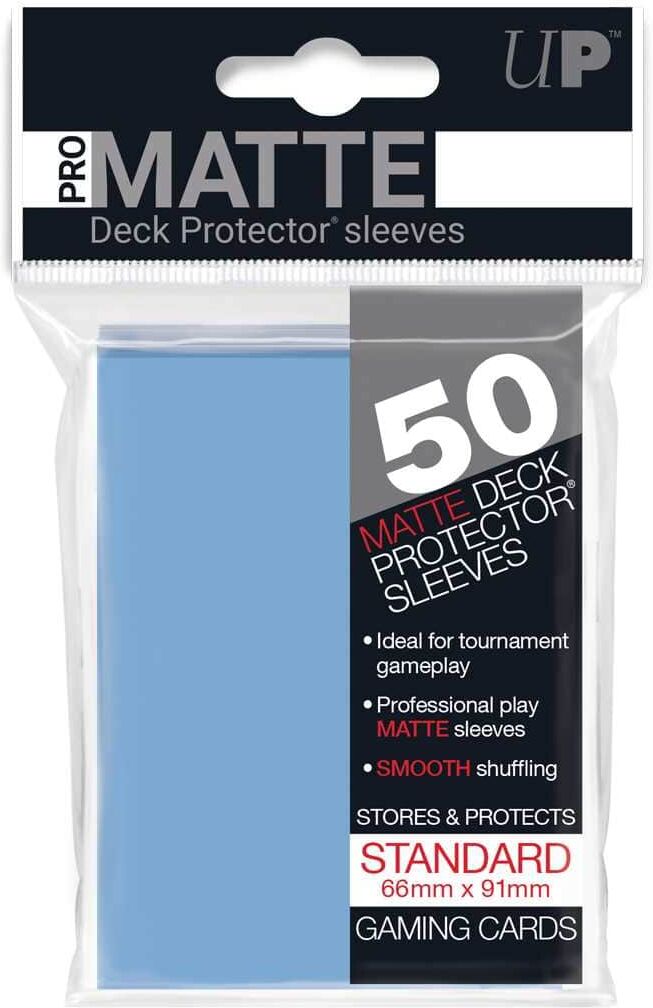
Ultra PRO Matte Deck Protectors - Light Blue - 50ct - Card Game AccessoriesProtect your standard-sized trading cards with these Ultra PRO Matte Deck Protectors. Each pack contains 50 light blue sleeves made from acid-free, non-PVC polypropylene, helping to shield cards from scratches and everyday wear. The matte finish reduces glare under bright lighting, while the textured matte back prevents sleeves from sticking together during play. This finish also supports smooth, consistent shuffling for card games and trading card activities. The sleeves are a practical choice for players who want a uniform look and added protection for a standard trading card deck.3,32 £*Shipping: 3,95 £Secure redirect to the provider
-
Ultra PRO Matte Small Deck Protectors - Blue 60 ct - Trading Card AccessoriesProtect small-format trading cards with 60 Ultra PRO Matte Deck Protectors. Acid-free, non-PVC polypropylene prevents scratches and wear. Matte finish reduces glare under bright lighting. Textured back prevents sleeves from sticking together for smooth shuffling. Designed for small-size cards used in Yu-Gi-Oh! and Cardfight!! Vanguard games.3,69 £*Shipping: 3,95 £Secure redirect to the provider
-
'Genitive or accusative?'
The genitive case is used to show possession or relationship between nouns, while the accusative case is used to show the direct object of a verb. In general, the genitive case is used to indicate ownership or association, while the accusative case is used to indicate the direct object of a verb or the object of a preposition. The choice between genitive and accusative depends on the specific context and the grammatical rules of the language being used. **
-
Dative or accusative?
Dative and accusative are two different cases in grammar that indicate the relationship between a verb and its object. The dative case is used to show the indirect object of a verb, while the accusative case is used to show the direct object. To determine whether to use dative or accusative, you need to consider the verb in the sentence and identify whether the object is receiving the action directly (accusative) or indirectly (dative). **
-
Genitive or accusative?
The genitive case is used to show possession or relationship between nouns, while the accusative case is used to show the direct object of a verb or the object of certain prepositions. In general, the genitive case is used to indicate possession or belonging, while the accusative case is used to indicate the direct object of a verb or the object of a preposition. The choice between genitive and accusative depends on the specific context and the grammatical rules of the language being used. **
-
In which cases is the preposition "auf" used in the dative and accusative cases?
The preposition "auf" is used in the dative case when indicating location or position, such as "auf dem Tisch" (on the table) or "auf der Straße" (on the street). It is used in the accusative case when indicating direction or movement towards a place, such as "auf die Insel" (to the island) or "auf den Berg" (up the mountain). **
* All prices are inclusive of VAT and, if applicable, plus shipping costs. The offer information is based on the details provided by the respective shop and is updated through automated processes. Real-time updates do not occur, so deviations can occur in individual cases. ** Note: Parts of this content were created by AI.